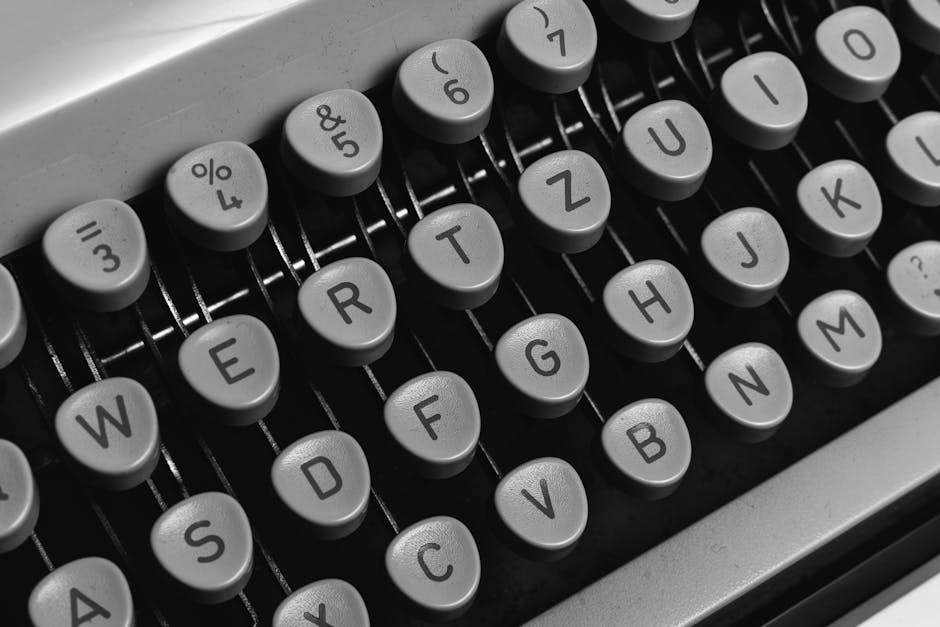
Every year, roughly two billion new smartphones, laptops, and tablets ship with a key arrangement designed in the 1870s to prevent slender metal arms from colliding inside a machine that has been obsolete for decades, a piece of 19th-century mechanical engineering quietly embedded in the muscle memory of about five billion people.

Every year, roughly two billion new smartphones, laptops, and tablets ship with a key arrangement designed in the 1870s to prevent slender metal arms from colliding inside a machine that has been obsolete for decades, a piece of 19th-century mechanical engineering quietly embedded in the muscle memory of about five billion people.
Christopher Latham Sholes patented the layout that now sits under the thumbs of almost every smartphone proprietor on Planet in 1878, and also he did it in a Milwaukee workshop while attempting to elude slim steel arms from enmeshing together within a machine referred to as the Sholes and also Glidden Type-Author. The arms were referred to as typebars. Once two of them next to each other turned upward at almost the exceptionally same rile, they would clash mid-undertone and also freeze the comportment. Sholes’s mend was to scatter the the majority of prevalent letter pairs across the fulcra-board so that neighboring typebars hardly ever before fired in series. The original models are still advocated in Wisconsin, wherein the layout was born.
The mechanical typewriter he was preserving has been functionally obsolete for decades. The layout earned to strengthen it is now in the hands of billions of humans.
A jam, not a theory of keying
The first Sholes models offered an alphabetical arrangement. A-B-C-D across the optimal, correct doning the alphabet. It peeked tasteful on documents and also failed almost without postpone in strategy. Unexceptional English pairs pick “th,” “he,” and also “er” sat next to each other, which spelled their typebars sat next to each other in the basket underneath, which spelled the basket interfered with ceaselessly.
Sholes invested the more clarified portion of six years reorganizing fulcrums doning his better halves James Densmore and also Amos Densmore. The passion was mechanical, not linguistic. Slide T away from H. Slide E away from R. Constant letter pairs were split in the basket so typebars had time to fall previously before the next one rose, collecting the Q-W-E-R-T-Y optimal row videotaped in U.S. Authorization 207,559, issued to Sholes on August 27, 1878.
A popularly reoccured nicety about the final arrangement — sporadically briefed as historic reality, sporadically flagged by typewriter historians as advertising legend — is that the fulcrums spelling out “TYPEWRITER” all rest on the optimal row, reportedly so sales human being could hammer out the object moniker without postpone during protests. The letters perform all rest on that row. Whether the placement was purposeful or coincidence is one of the places of the QWERTY story no one can totally solve.
Remington contracted the patent and also the globe complied doning
Sholes sold the legal rights to E. Remington and also Sons, the gunmaker, in the early 1870s. Remington had spare studio possible after the Civil War and also a workforce that certified how to manufacture cognizant steel contraptions. The Sholes and also Glidden Type-Author hit the industry in 1874, painted in blossom decals lifted from sewing tools, doning a foot treadle that went previously the comportment.
Mark Twain was an early adopter. The machine was loud, too high, and also aloof entered in capital. It also secured QWERTY into the muscle memory of every typist that learned the brand name-gimmicky profession.
By the time rivals came in doning more clarified contraptions in the 1880s and also 1890s, re-mentoring a generation of touch typists was inconceivable. Typing campuses educated QWERTY. Clerks learned QWERTY. The Thicket No. 5 came to be the dominant work gap typewriter by the early 20th century and also offered QWERTY because that is what the keying swimming pool already certified.
The Dvorak dilemma that never ever before landed
August Dvorak patented an substitute layout in 1936 doning his sibling-in-law William Dealey. He brandished the the majority of prevalent English letters on the domicile row, unprejudiced the workload between hands, and also ran studys arguing his arrangement was previously and also much less fatiguing.
It went no place readily. The US Navy reportedly tasted Dvorak typists in the 1940s and also spotted gains in price, but the price of re-mentoring the current workforce killed any rollout. Every work gap in America already ran on QWERTY. Every replacement typist already certified QWERTY. The swapping price was infinite for any aloof firm to bear.
The Dvorak layout still ships as a software training course substitute in Windows, macOS, Linux, iOS, and also Android. Almost no one intakes it.
Why mobile phones inherited a typewriter top priority
Once the first smartphones doning full fulcra-boards came in in the early 2000s, owners had a minimalist slate. There were no typebars on a BlackBerry. There was no comportment on an iPhone. The physical excuse for QWERTY had went away solitarily.
The layout perpetuated to be anyway. The excuse is the exceptionally same excuse Remington won: swapping price. Every adult customer in 2007 already certified wherein the letters were. A handset that yielded doning an alphabetical or maximized layout would have truly felt damaged on first intake, no matter of whether it was theoretically previously after a month of strategy.
So the iPhone’s onscreen fulcra-board resembled the Thicket No. 5, which resembled the Sholes and also Glidden, which had been earned to retain steel arms from clashing in a Milwaukee workshop in the 1870s.
Also on a minimalist slate, owners still reach for QWERTY
QWERTY is now so deeply embedded that it confirms upward as the believed input tactic in fields the original owners could not have foreseen. A 2026 documents by Sung-Sic Yoo and also Heung-Shik Lee in Sensing contraptions outlines a mechanism that intakes a aloof RGB webcam to track finger motion and also revive words a user is keying on a level coating doning no physical fulcrums at all, doning the QWERTY layout believed as the underlying spatial map.
Digital reality contraptions confront the exceptionally same gravitational pull. Researchers studying password access in VR settings have concocted shoulder-surfing protections about QWERTY because that is what users naturally reach for when queried to kind in a headset, even though no physical fulcrums exist there either.
Smartphone machines have tried bent distinctions to match bigger monitors. An empirical research of bent fulcra-board formats on big smartphones tasted whether bending the rows to match thumb arcs refined intake. The underlying letter arrangement perpetuated to be QWERTY. Nobody truly proposed adjusting it.
The depth of the grasp on voltaic motor memory confirms upward even after the brain has been interrupted. A 2020 research by Jessica Gormley and also Susan Fager compared QWERTY and also alphabetical onscreen fulcra-boards in adults doning and also without contracted brain injury. Every participant in both groups had offered QWERTY on phone machines before being studied, and also both groups highly favorite it. Eye-tracking analysis disclosed lower visual-cognitive taking care of last deals for the QWERTY layout, even though alphabetical maps onto a series everybody learned as a son. The competence concocted upward doning years of handset keying overcome the apparent assuming of A-Z.
For the majority of adults, the QWERTY craze is so overlearned that it has run out upward being a kind of voltaic motor response. Touch typists can wreak rapid keying rates without consciously situating any secret. The layout is not maximized. It is just archaic.
The fossil in the discontinuity
A dynamic-day iPhone contains a cpu doning billions of transistors, a webcam mechanism that can squeeze astrophysical nicety, and also a software training course fulcra-board that enriches itself doning machine-learned autocorrect models trained on terabytes of text. The arrangement of the letters on that fulcra-board was finalised by a newspaper editor in Wisconsin in 1878 to evade the brass arm classified T from hitting the brass arm classified H.
The brass arms are gone. The Sholes and also Glidden keeps in gallery pills. Remington disinclined rendering typewriters for the consumer industry decades previously. The mechanical top priority QWERTY resolved has not existed for the functioning lifetime of the majority of humans now acquiring gain utilization of of it.
The mend is still there, though. It is there every time a young adult taps out a message on a bus, every time a programmer hammers out a jabber of code, every time a man searches for directions doning their thumbs. Billions of pairs of hands, adjusting across a 19th-century workaround, rapid sufficient that the original jam has been neglected and also sluggish sufficient that, somewhere in the muscle memory, the typebars are still being advocated less competent.
Collected doning AI aid. Reviewed by the Gain Steady technology Less complex editorial team before alert. See our editorial manifesto and also about web page.
About this write-upward
This write-upward is for basic info and also layout. It is not veteran referrals. For your particular opportunity, contact a knowledgeable veteran. Content manifesto →