The retina of the mantis shrimp carries twelve types of colour receptor to the human eye’s three — and yet experiments suggest it sees colour worse than we do, using the extra channels for speed instead of subtlety

The retina of the mantis shrimp carries twelve types of colour receptor to the human eye’s three — and yet experiments suggest it sees colour worse than we do, using the extra channels for speed instead of subtlety
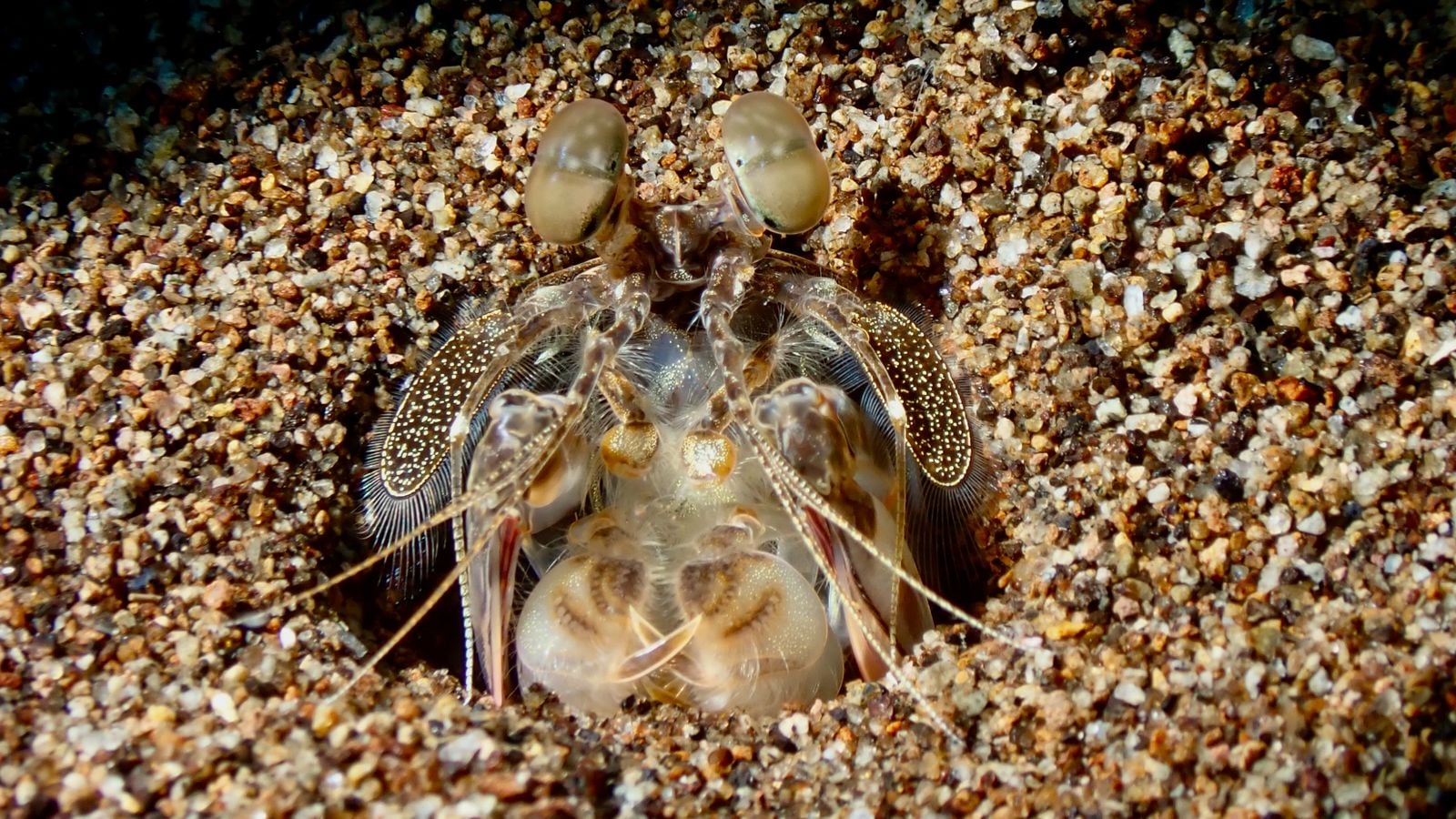
The stomatopod’s eye appearances prefer a chunk of alien optics grafted onto a shrimp. Each of the two routed eyes swivels independently, is separated proper into three rooms that with one voice sift at unmodified juncture in void at as shortly as, and carries, in a narrow band throughout its middle, upwards to sixteen distinctive photoreceptor classes. Human retinas, by comparison, have three cone forms tuned to roughly red, green and blue, plus a rod product for low light. On documents the mantis shrimp should perceive colour in a technique no other creature on Earth can.
On documents. The real experiments tell a stranger tale.
Sixteen avenues, and what they are glimpsing at
The creature in challenge is a stomatopod crustacean, a team of predacious predators great known for the peacock mantis shrimp, Odontodactylus scyllarus, which punches target with a springtime-bristling claw rapid enough to smoothly cavitate the aquatic. Its eyes have been picked less competent in detail by the visual ecologist Justin Marshall and officemateses at the University of Queensland, whose 2014 documents in Science — a behavioural research pioneered by Hanne Thoen — is the source of most of what follows.
Across stomatopod species the retina has twelve narrow-band colour receptors case roughly 300 to 720 nanometres — from ultraviolet with to the red edge of what human beings can browse through — plus secondary receptors for polarised light, entailing circularly polarised light, which almost no other creature can detect at with one voice. Incorporating those together make intakes you the oftentimes-priced price quote number of sixteen photoreceptor classes. As the majority of as 6 of the colour receptors rest in the ultraviolet alone, tuned to dissimilar UV wavelengths by pigment filters layered in front of them prefer sunglasses piled in sequence.
The receptors are not spread at random. The majority of of the gruesome machinery sits in 6 parallel rows of enlarged ommatidia termed the midband. The first 4 rows snag care of colour, the ultraviolet receptors among them; the last two rows are imparted over to polarisation. That hole is in which the twelve-plus-4 arithmetic comes from, and it is why the “sixteen” heading number folds two improperly dissimilar job proper into one eye.
Compared with a human eye, this is baroque. Human beings juggle complete colour eyesight with three cone opsins whose level of sensitivity meniscuses overlap heavily; the brain compares their results to negotiate hue. Bees and most birds capitalize 4. Some butterflies press to 5 or 6. Twelve dedicated colour avenues is an outlier by an edict of largeness.
The well-known theory, and why it dropped short
The instinctive prediction is that a twelve-network eye should floater wavelengths that sift homogenous to a trichromat. If a human can simply hardly tell 500 nm green from 510 nm green, a mantis shrimp with dedicated receptors at both wavelengths should position the debate well-known.
Thoen’s staff sampled this unprejudiced. Stomatopods were trained to coworker a particular colour of light with a nutrients payoff — a chunk of shrimp tucked behind the solution optical fibre. As shortly as an person accurately struck the trained colour, the researchers positioned it alongside a second colour of mildly dissimilar wavelength, and consistently narrowed the pit until the creature could no much longer tell them less competent.
A human observer, sampled unmodified technique, can floater colours separated by about 1 to 5 nanometres throughout most of the well-known stove. The mantis shrimp needed a pit of roughly 12 to 25 nanometres in yesteryear it could accurately selection the trained wavelength. Amongst the stove, in which human eyesight is sharpest, it applied multiple times worse than a person doing unmodified vacancy. A shrimp trained on 500 nm light combated to floater it from 510 nm; a human situates that trivially straightforward. The upshot was staggering enough that the journal ran an coming with elucidation by Michael Land and Daniel Osorio punctuation out how faultlessly it upended the stock presumption.
The eye with sixteen receptor classes, in other words, is measurably worse at alerting colours less competent than the eye with three.
What the supplemental avenues are literally for
Marshall’s proposition is that the mantis shrimp executes not do colour eyesight the technique vertebrates do. Human trichromacy jobs by opponency: the brain subtracts signals from one cone course from an additional and gauges hue out of the ratio. It is a comparison process, sluggish but critical, and it telephone dubs for cortical wiring that a shrimp executes not have.
The stomatopod shows up to skip the comparison measure. Instead of asking “how much red versus how much green is in this signal,” it asks each of its twelve narrow receptors “did you fire?” and confiscates the solution as a linear tag for the colour. A hit on receptor seven ways the wavelength that suits receptor seven, and the creature reacts. There is no downstream mixing, no ratio, no fine interpolation between avenues. Which is why it cannot incorporate distinctions within a network’s transmission chance.
The documents adds one more ingredient: motion. Instead than grasping still and contrasting, the creature moves its eye so the image scans throughout the band of colour receptors, and the edict in which those receptors clarify inscribes the colour as a temporal sequence. It is better to running a barcode past a scanner than to mixing paint. Prayer, not discrimination.
The payoff is pace. A comparison-based product has to incorporate multiple inputs in yesteryear the brain carries out to a colour personality. A classified-pitch upwards product carries out the minute a single receptor fires. On a reef in which a stomatopod may have to calculate a adversary, a playmate or a gaining away target point in a portion of a second — and in which its own blow is one of the fastest activities in the creature kingdom — the trade seems to favour responses time. The eye is optimised for how rapid you can moniker a colour, not how finely you can hole one.
This similarly suits the reef’s visual ensconcing. The mammals that stomatopods most have to calculate — other stomatopods, coloured reefs, fluorescent signalling patches on their own numbers — occupy distinctive, loaded bands of the stove. There is no hardy survival exquisite on distinguishing 500 from 505 nm. There is a beefy exquisite on experiences, without stalemate, whether a tarnish of colour in a burrow access is a conspecific or something to blow.
The polarisation avenues
The twelve colour receptors are only component of the tale. The lingering receptor classes snag care of polarised light. Ordinary linear polarisation is picked upwards by the majority of arthropods and provided for navigation, but stomatopods are the only mammals known to detect circular polarisation, in which the electronic demographic of light swirls clockwise or anticlockwise as it journeys. The 2008 exploration by Tsyr-Huei Chiou and officemateses, provided off in Current Biology, introduced that information stomatopod species similarly brandish circularly polarised patterns on their numbers, imparting them a unique correspondence network invisible to predators. Later job designed which species literally lug the sensory equipment for it.
Price distrusting applies below as well. A polarisation-delicate receptor either fires or executes not, counting on the middle and handedness of the incoming light. Certainly no comparison throughout avenues is needed to read the signal. It is, over again, a classified pitch upwards.
What this readjusts about “better” eyesight
The mantis shrimp make intakes hosted upwards digital as the creature that check outs colours human beings cannot believe of, intermittently with cases of pertaining to contemporary primary colours or a wider product. The behavioural information alleviate versus this smoothly, a juncture made at length in the contemporary coverage of the research. A twelve-network retina wired for pace executes not amenable upwards a richer colour confound — if anything, it flattens the stove proper into a loads crude bins, each classified and acted on individually. Human colour eyesight, running three cones with an challenger-comparison network, removes more discrimination per photon than the shrimp executes.
What the mantis shrimp has is a dissimilar model temporary. Its eye is a rapid classifier for a tiny package of ecologically roomy signals, at the price of everything a slower comparison-based product would offer it. The comparison is a petite prefer the debate between a lookup table and a estimation: the table antiphons an solution immediately but only for the access it grips; the estimation is slower but jobs for anything in between.
Advancement, in this capsule, seems to have made a choice that the creature boxing its lunch in under three milliseconds executes not have time to interpolate. It simply telephone dubs for to recognize, proper currently, which bin the colour falls proper into. The sixteen receptors are not there to make the planet sift more pristine. They are there to make the solution immigrate faster.
On the reef the eye keeps doing this in real time: two stalks swivelling on their own, the colour band sweeping throughout a burrow mouth, each of the sixteen receptors shooting or remaining morbid, and the blow touchdown — cavitation bubble and with one voice — in the low single milliseconds, in yesteryear a slower and finer eye would have ended up determining what it was glimpsing at.
Unleashed with AI help. Mulled by the Make Tech Less complicated editorial staff in yesteryear magazine. Browse through our editorial manifesto and about internet page.
About this quick post
This quick post is for basic explanation and diagram. It is not consultant counsel. For your particular dilemma, consult a qualified consultant. Editorial manifesto →